
Fractional CMO for CX Tech, CCaaS and B2B SaaS Teams
Turn Scattered GTM Activity Into a Working Growth System in 90 Days
One senior GTM owner to align narrative, proof, and funnel sequence so execution creates momentum, not noise.
A focused 90-day engagement with clear ownership, execution priorities and handoff.
If the demo goes well but the deal goes quiet, this sprint is built for you.
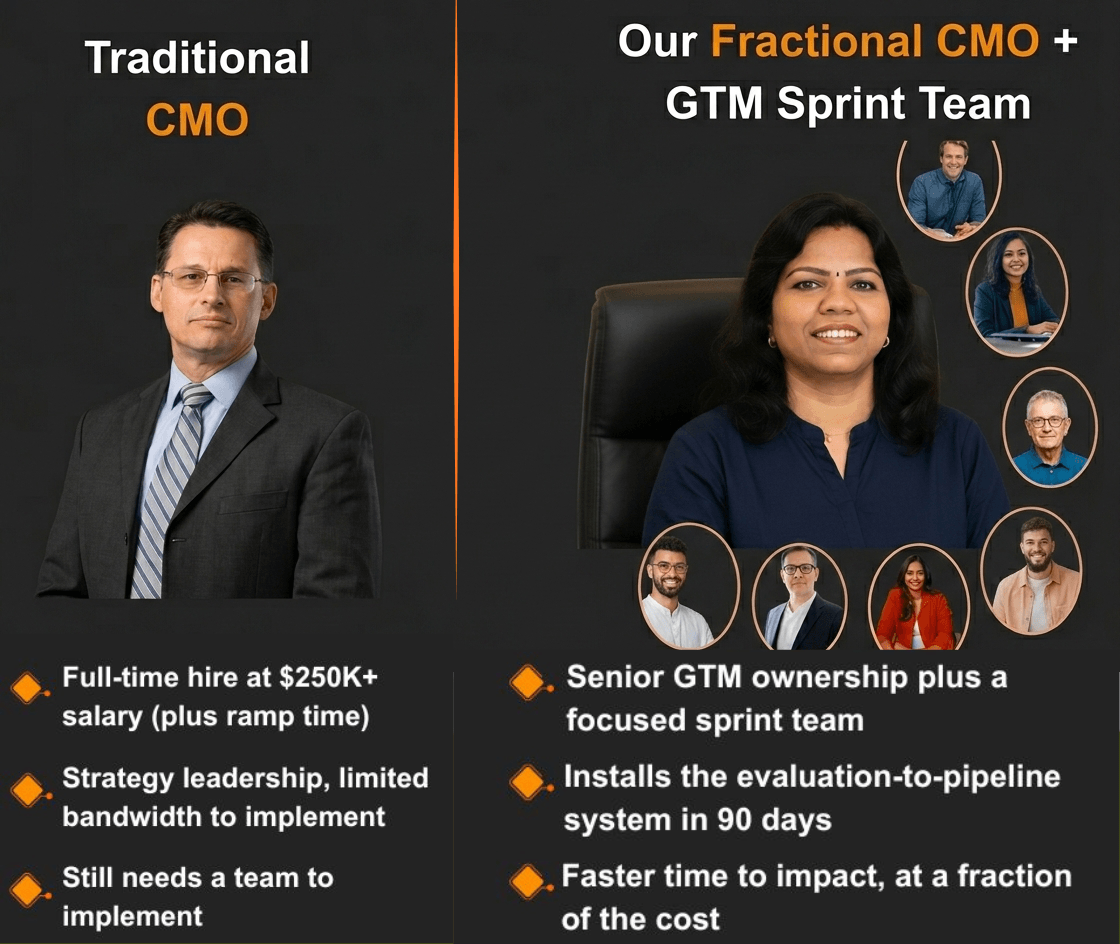
Agencies execute. Full-time CMOs take time.
There’s a better path to GTM traction in complex B2B technology
Your product may work. Customers may exist. The team may already be executing.
But positioning, demand, sales, proof, partners and pipeline can still move in different directions.
The problem is not always another campaign or another hire. It is often the absence of one senior owner deciding what matters first, aligning the work around it, and staying close enough to execution to correct what is not moving.
At FractionalCMO10x, we work as that GTM owner for CX Tech, CCaaS and B2B SaaS teams.
🚫 Not an agency running campaigns while the funnel and handoffs remain broken.
🚫 Not a $250K+ CMO hire who sets strategy but still needs a team to implement.
🚫 Not a consultant delivering a deck and leaving your team to interpret it.
We set the priorities. We align the team. We build or direct the missing work. We review what is moving and correct what is not.
One owner. One system. 90 days to measurable traction.
The reason this works is simple: Complex B2B GTM often breaks at the system level, not the channel level.
Why B2B Technology Growth Feels Stuck
Complex B2B buyers form preferences across multiple surfaces before and during the sales process. The longer the buying cycle and the larger the committee, the more GTM has to support that journey.
🕸️ Enterprise buyers evaluate for months, not days. The buying committee may involve business leaders, operations, IT, security, procurement and finance. If GTM is designed only for the first conversation, trust can weaken as evaluation expands.
🕸️ Buyers default to platforms they already know. In CX Tech that may mean established platforms such as Genesys, NICE, Five9 or AWS Connect. In other B2B SaaS categories, the same preference can form around the familiar incumbent or perceived safer choice.
🕸️ Your wider market presence matters alongside your website. Buyers may validate you through search, reviews, marketplaces, analyst coverage, communities, partners, customer proof and competitor comparisons. If those surfaces do not support the same story, website traffic alone will not fix the problem.
🕸️ No one owns the full GTM system. Agencies run channels. Internal teams execute tasks. But no one connects narrative, proof, sequencing, and ecosystem presence into one system. Activity increases. Pipeline does not.
When no one owns the evaluation system end to end, execution fragments and conversion breaks quietly.

Why Pipeline Stalls Even When Everyone is Busy
Every quarter starts the same:
“Maybe this campaign will land.”
“Maybe this new hire will level things up.”
“Maybe this quarter, pipeline will finally compound.”
And then… it does not.
Here is what that looks like in B2B technology:
Marketing ships activity (content, ads, webinars), but nobody owns what happens after interest.
Sales runs deals, but buyers form a shortlist based on what feels safest before your reps ever get a fair shot (security, integrations, procurement).
Agencies run channels, but no one owns the full sequence from first impression to shortlist to evaluation to pipeline.
Product and Customer Success have insight, but it rarely becomes narrative, proof, or enablement that moves enterprise evaluation.
So you end up juggling:
SEO agency. Paid vendor. Cold email freelancer. A CRM full of “maybe.”
And no clear answer to the only question that matters:
What is actually moving enterprise evaluation forward, and what is stalling it?
This is the ownership gap.
FractionalCMO10x closes that ownership gap with one accountable GTM owner across positioning, demand, proof, funnel sequence and pipeline, so execution is working toward the same buyer and business outcome.
The Cost of Waiting in CX Tech
Let us say you wait another quarter. You push forward with what you have. A few campaigns, some freelancers, scattered efforts.
What does that quarter actually cost?
$20K to $50K+ in spend with no clear pipeline attribution.
Another 12 weeks where buyers evaluate you and choose someone else.
Enterprise deals that stall without clear objections.
RFPs where you are included for comparison, not preference.
The familiar platforms keep showing up where enterprise buyers check first.
This is what happens when no one owns the system.
Not spend. Not effort. Not intent.
Ownership.
The 90-Day Sprint: How the GTM System Is Installed
This is not a long engagement. And it is not scattered execution.
The 90-Day Sprint brings the highest-priority parts of GTM under one operating system and one accountable owner.
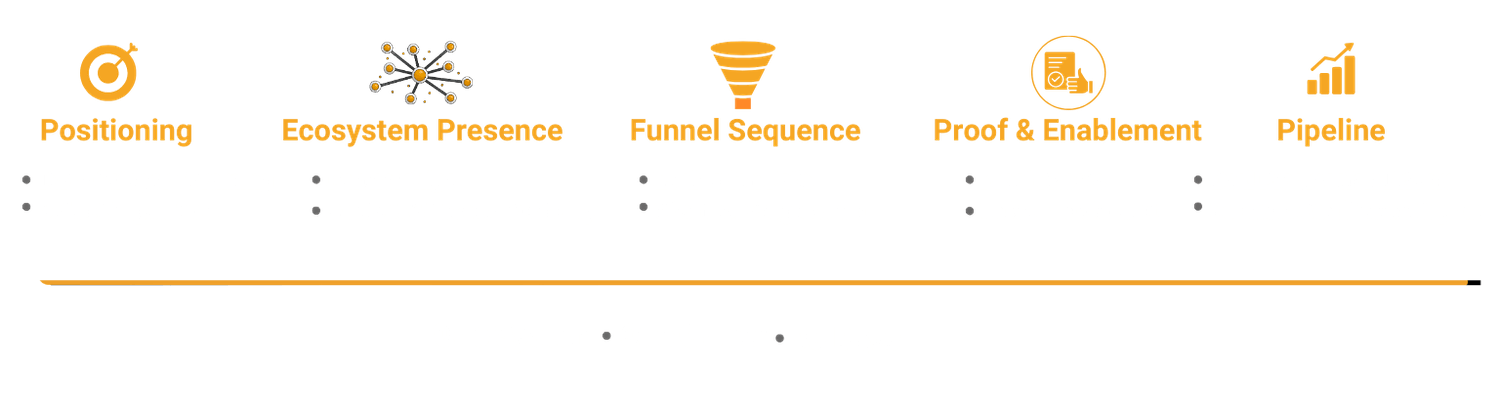
Positioning: We clarify who the product is for, why it matters, how it is different and what buyers need to understand quickly. Not slogans. Clear answers that survive IT, procurement, and security review.
Ecosystem Presence: We strengthen the surfaces buyers use to discover, validate and compare the company, including search, marketplaces, reviews, partners and category proof where relevant.
Funnel Sequence: We fix the sequence buyers encounter from first interest through evaluation so message, proof and next steps build rather than reset trust.
Proof & Enablement: We build and align the proof buyers, champions and sales teams need to move a decision forward.
Pipeline: We make pipeline movement visible enough to see what is creating traction, what is blocking it and what should change next.
The Sprint: How the 90 Days Are Run
Three phases. One GTM system. Clear ownership from day one.
This is not an open-ended engagement.
It is a focused 90-day sprint that moves the highest-priority GTM constraints from diagnosis into execution.
Three phases. Clear exits. Clear ownership.

Phase 1: Diagnose & Map the GTM System (Day 1 to 14)
We identify where enterprise buyers lose confidence and lock the execution order for the next 90 days so momentum compounds instead of resetting.
External audit: positioning, ecosystem presence, trust proof and buyer risk questions, competitor framing (security, integrations, procurement)
Internal review: site flow, offers, funnel leaks, sales assets, CRM signals
Roadmap ranked by impact on shortlist and evaluation movement
This phase ends with
A clear GTM system map
Prioritized constraints tied to evaluation behavior
Alignment on what will move pipeline forward first
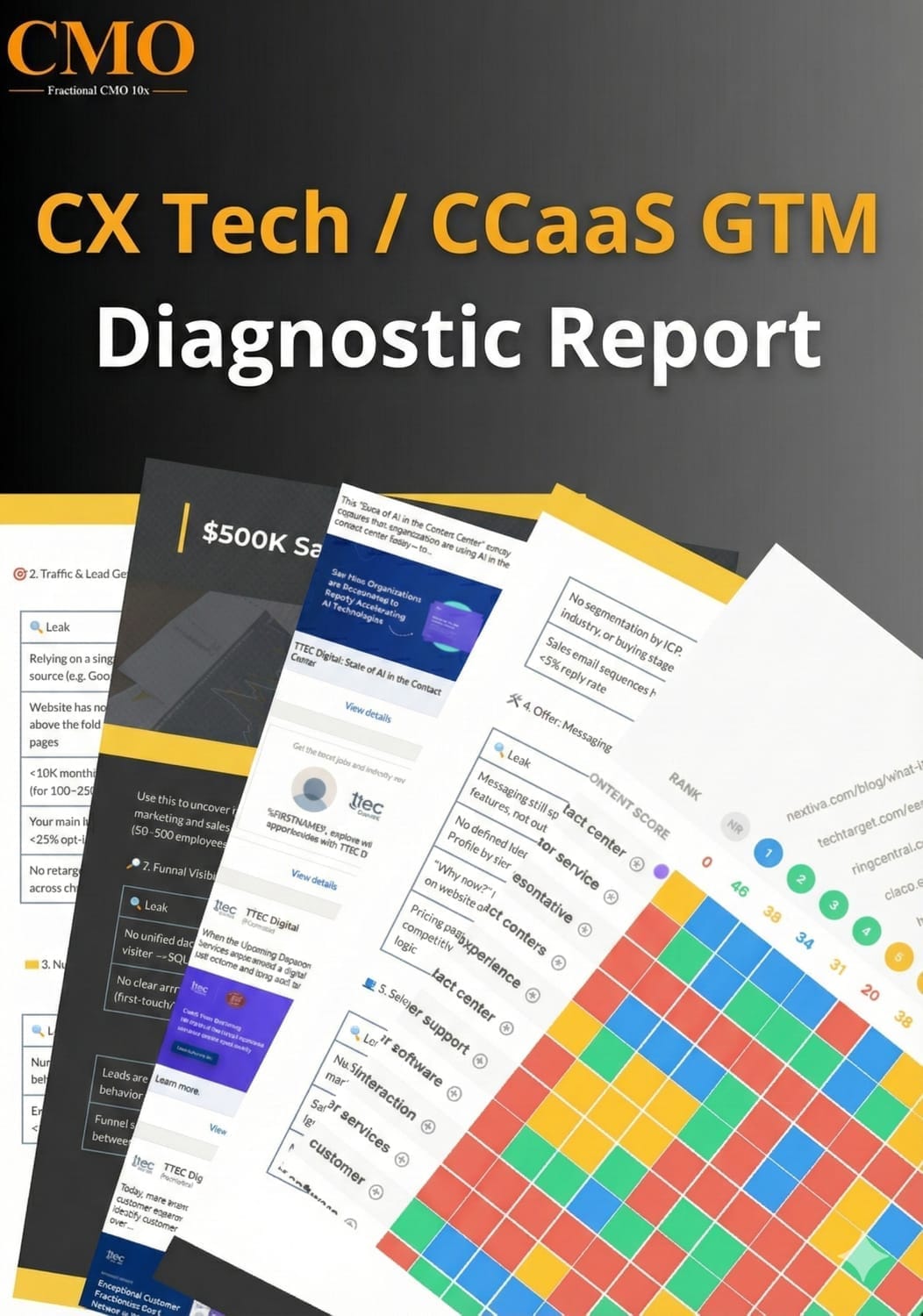
If you completed the CX Tech GTM Diagnostic, Phase 1 compresses and your credit applies.

Phase 2: Install the System (Day 15 to 75)
We install the GTM system where CX buyers actually evaluate and shortlist.
Positioning installed where buyers evaluate and sales explains value
Ecosystem presence upgraded: partners, marketplaces, reviews, analysts
Proof built for enterprise risk: comparisons, case signals, objections
Funnel sequence fixed so interest progresses into shortlist and evaluation
Decision-stage measurement in place so you can see what moves deals
This phase ends with
Updated core assets buyers touch first
Proof and enablement packages sales can use immediately
Weekly progress with simple decision signals

Phase 3: Optimize & Transfer (Day 76 to 90)
We finalize what works, document it, and lock the operating cadence.
Optimize what is already producing movement
SOPs, dashboards, and repeatable sequences finalized
Team handoff
By the end of the sprint
You have a working GTM system, not a strategy deck
Pipeline movement is explainable and measurable
Your team knows exactly what to prioritize next
After 90 days, the system is operational. Teams may run it internally or retain us as the GTM owner.
Need pipeline conversations faster than a full system install? The 45-Day Execution Sprint is further down this page.
What the Sprint Delivers
After 90 days, you leave with more than recommendations. You have GTM priorities, working assets, reporting and a working system your team can keep running.
Diagnostic Output
Positioning that holds under enterprise scrutiny
Your ICP, category framing, and value proposition are clear enough for buyers to repeat internally. The story survives IT review, procurement questions, and security conversations without falling apart.
Ecosystem visibility that builds trust before sales engages
You show up consistently across app marketplaces, partners, analyst mentions, and review platforms where CX buyers form opinions long before a demo is booked.
A funnel sequence that matches how enterprise buyers evaluate
Narrative, proof, and risk reduction are sequenced for multi-threaded enterprise buying. Consensus builds across stakeholders instead of fragmenting between teams.
Proof and enablement assets that move deals forward
Case signals, comparisons, and objection handling are built for enterprise risk reduction and used before deals stall.
Pipeline visibility that shows what is working
You can see what is advancing evaluation, what is stalling, and where intervention is required. Pipeline behavior becomes visible, explainable and actionable.
A system your team can run
SOPs, dashboards, and documentation are in place so execution does not depend on individual memory, heroic effort, or repeated reinvention. You leave with a system, not a dependency.
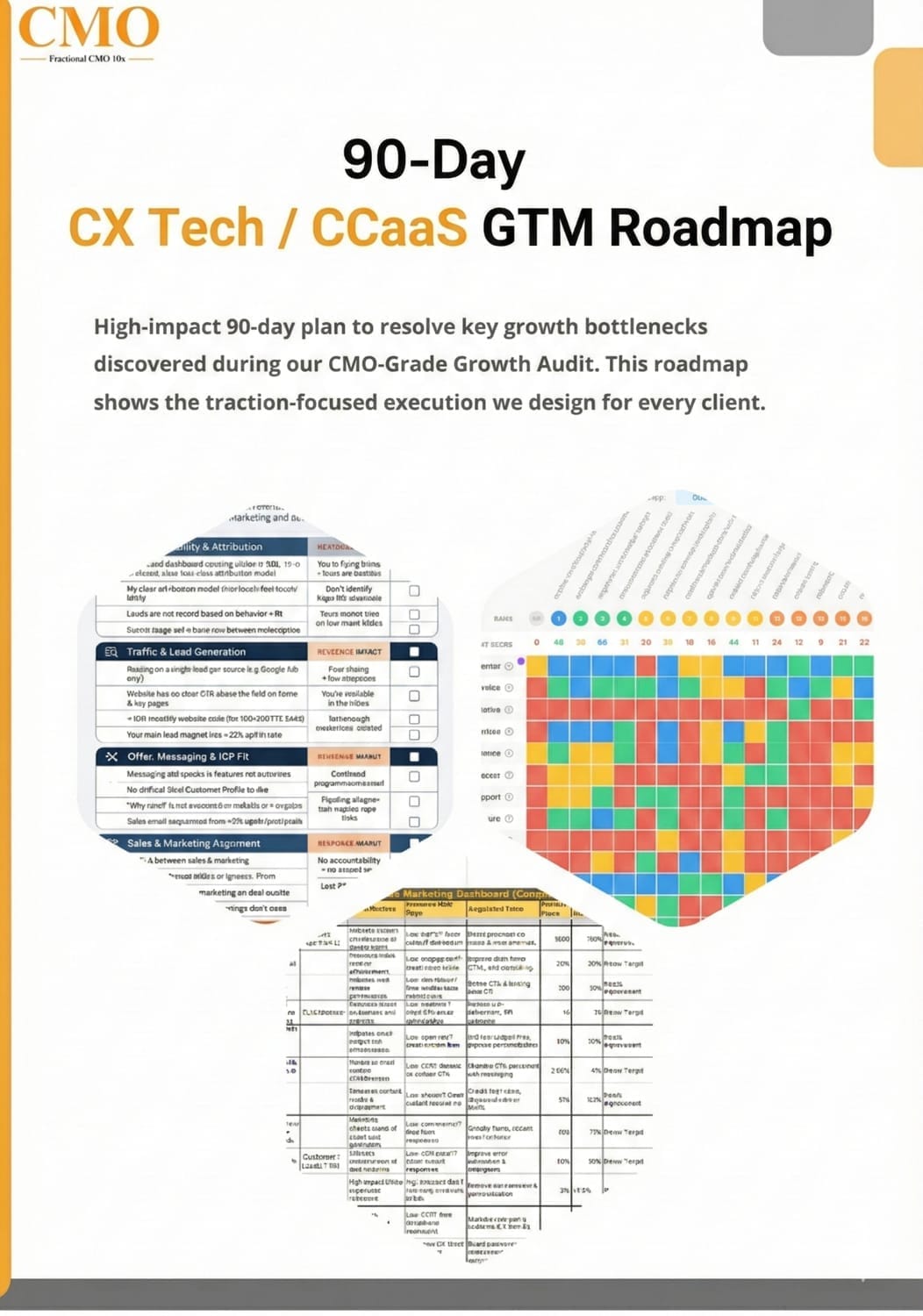
90-Day Execution Roadmap
After 90 Days: What Happens Next
The sprint ends.
The system does not.
You have three paths:
Run it internally
Your team has the priorities, SOPs, dashboards, assets and documentation needed to keep the work running without external support.
Continue with Fractional CMO oversight
We stay accountable for GTM priorities, team direction, performance review and ongoing optimization.
Move into focused Consultant Mode
If the broader GTM work is in place but one area still needs senior support, we can stay involved in that specific area without continuing the full sprint.
When the 90-Day Sprint Makes Sense
The 90-Day Sprint is the right route when the problem is larger than one campaign, channel or asset.
Strong fit when:
Marketing, sales, product, customer proof or partner activity are moving without one clear GTM owner
Positioning, demand, conversion and pipeline are not working together
Your team can execute but needs senior direction, clear priorities and regular performance review
You need one accountable GTM leader to set direction and stay close to execution
Growth is still too dependent on referrals, founder effort, scattered activity or inconsistent pipeline
Enterprise evaluations are slowing because the message, proof or buyer confidence does not carry through the buying committee
When 45 Days Beats 90: The Execution Sprint
Need pipeline conversations faster than a full system install?
The 45-Day Execution Sprint is for companies where the core GTM direction is already clear.
The product works. The ICP and buyer are understood. Customers may already be paying and renewing. Positioning is clear enough to sell.
The constraint is simpler: there is no repeatable outbound motion creating new enterprise conversations.
Pipeline still depends on referrals, occasional inbound leads, founder outreach, or inconsistent prospecting.
In that situation, the company needs the outbound engine built and running.
We build the target-account and contact system, outbound infrastructure, messaging and sequences, launch the campaigns, optimize from buyer response, report on conversations, and hand over the working system.
The target outcome is agreed before launch, so success is measured by meaningful buyer movement, not activity volume.

Engagement Levels
Three engagement levels. Same system. Different depth of ownership.


GTM Navigator
(3-month minimum)
Strategy and direction. Your team executes.
Senior GTM ownership and sprint direction, with your team executing the build.
What’s Included:
Dedicated Fractional CMO (8 to 10 hrs per week)
90-day sprint roadmap ranked by pipeline impact
Positioning, narrative, and ICP alignment
Ecosystem visibility strategy (marketplaces, analysts, reviews, partners)
Weekly leadership reviews with next actions
Pipeline visibility tied to evaluation and deal progression
SOPs and handoff documentation
Best for: Teams with in-house execution capacity and a need for senior GTM ownership.

⭐ Most Popular
GTM Accelerator
(3-month minimum)
Strategy and execution. We own both.
GTM ownership plus execution support across the surfaces that shape enterprise evaluation.
What’s Included:
Dedicated Fractional CMO (10 to 15 hrs per week)
90-day sprint roadmap ranked by pipeline impact
Positioning and messaging installed across website and sales story
Ecosystem execution (marketplaces, partners, analysts, reviews)
Proof and enablement asset build (comparisons, case signals, objection handling)
Campaign execution where buyers actually are (paid, LinkedIn, email, outbound support)
Funnel and CRM optimization
Weekly reviews, pipeline signals, and sprint reporting
SOPs and handoff documentation
Best for: Teams that need execution support to move enterprise evaluation faster.

45-Day Execution Sprint
A focused outbound build when pipeline is the known constraint.
When the product, buyer and market direction are sufficiently clear but the company lacks a working outbound motion, we build and run the focused system.
What is included:
Target-account and buyer validation
Contact research
Outreach infrastructure
Email and LinkedIn sequences
Campaign management and iteration
Weekly conversation reporting
Full handover
The outcome is agreed before launch so success is measured by meaningful buyer movement, not activity volume.
GTM Ownership Models Compared
Choosing a GTM model is not about sticker price.
It is about who owns the system, how fast it moves, and whether pipeline becomes predictable.
Deep CX Tech Expertise. Broader B2B SaaS Application.
FractionalCMO10x (Navigator / Accelerator): Specialized in CX Tech and CCaaS. Deep understanding of enterprise evaluation, shortlist behavior, and ecosystem trust signals.
Full-Time CMO: Depends on hire. Category learning curve varies.
Marketing Agency: General B2B playbooks. Limited enterprise CX specialization.
In-House Team (Junior–Mid Level): Skill depth depends on hiring. Enterprise GTM experience may be limited.
Execution Capability
FractionalCMO10x (Navigator / Accelerator): One accountable owner across the entire GTM path. Strategy and execution integrated from day one.
Full-Time CMO: Strategy only. Must build or manage execution team separately.
Marketing Agency: Execution is their focus. Strategy is your responsibility.
In-House Team (Junior–Mid Level): Execution focused. Lacks senior strategic direction.
Speed to Results
FractionalCMO10x (Navigator / Accelerator): 90 Days to a working GTM system.
Full-Time CMO: 3 to 6 months to hire. Another 3 to 6 months to build strategy.
Marketing Agency: Long lead times. Channel execution without system integration.
In-House Team (Junior–Mid Level): Trial and error. Slow ramp without senior guidance.
Accountability
FractionalCMO10x (Navigator / Accelerator): Tied to pipeline and deal progression. Weekly reviews.
Full-Time CMO: Tied to performance, but often hard to measure.
Marketing Agency: Measured by channel metrics and deliverables. Not pipeline.
In-House Team (Junior–Mid Level): Little visibility into actual business impact
Flexibility & Scale
FractionalCMO10x (Navigator / Accelerator): Scale after the initial 3-month sprint. No long-term lock-in beyond that.
Full-Time CMO: High fixed cost regardless of output variability.
Marketing Agency: Rigid retainers; scope changes cost extra.
In-House Team (Junior–Mid Level): Scale requires hiring.
System Ownership
FractionalCMO10x (Navigator / Accelerator): Fully integrated GTM system. One roadmap. One accountable owner.
Full-Time CMO: Strategy-first, execution delayed until team is built.
Marketing Agency: Execution only. Strategy remains fragmented.
In-House Team (Junior–Mid Level): Mostly tactical. Lacks strategic cohesion
Still Have Questions? Let Us Clear Them Up.
Hiring a Fractional CMO is a significant decision. Below are the questions CX Tech, CCaaS, and B2B SaaS leaders ask most before committing.
Agencies execute tactics in isolation. Most fractional CMOs advise.
We operate as your GTM leadership function.
Positioning, ecosystem visibility, evaluation sequencing, proof assets, and pipeline measurement operate under one accountable owner. Strategy and execution are integrated inside a 90-day system install. Every deliverable is built by people who have led GTM inside CX Tech and CCaaS companies.
That usually means activity happened without ownership.
CX Tech companies rarely fail from lack of effort. They stall because no one owns positioning, trust surfaces, evaluation flow, and pipeline accountability together.
This model exists to fix that gap.
CX Tech, CCaaS and B2B SaaS companies with a working product and a GTM constraint that needs senior ownership. That may be scattered execution, weak positioning, inconsistent demand, missing outbound, partner activation or enterprise deal progression.
When your product works and customers renew, but pipeline remains unpredictable.
When buyers evaluate you, then default to familiar vendor.
When you have tried agencies or freelancers and still cannot explain why deals stall.
When your team is executing but no one owns the GTM system end to end.
Early-stage CX Tech teams use us to build GTM foundations before hiring internally.
Growth-stage companies use us to break through plateaus. If you are selling into enterprise CX buyers and pipeline matters, you are big enough.
The 90-Day Sprint builds the full GTM system: positioning, proof, ecosystem presence, funnel sequence and enablement. Choose it when you do not know why enterprise deals stall. The 45-Day Execution Sprint builds one thing: an outbound engine that starts enterprise conversations. Choose it when you already know exactly who to sell to and simply have no repeatable way to reach them. If you pick the wrong one, we will tell you before you pay.
It is agreed in writing before Day 1. The working definition: a substantive reply from a VP level or above contact at a company matching the agreed ICP, that opens a real business exchange. Auto replies and declines do not count. Because the definition is locked before the engagement starts, there is no argument about it afterwards.
Yes. Both are scoped per engagement. Product marketing covers positioning, packaging, launch and sales enablement, including partner marketplace listings. Partner marketing covers ecosystem mapping, joint value propositions, marketplace presence, co-marketing, event activation and partner enablement, built on more than a decade of marketplace launches across Genesys AppFoundry, Oracle and Salesforce. An ongoing retainer is also available when you need a senior marketing operator across several areas at once. Send a note and we will scope it.
You do, from the start. Domains, inboxes, account lists, sequences and every record sit in accounts you control. At Day 45 everything is handed over whether or not you continue. Nothing is held hostage to a renewal.
No fixed entry route. If the root cause is unclear, the Diagnostic is useful. If the problem is already known, we can go directly to Product Marketing, Partner Marketing, the 45-Day Execution Sprint, the 90-Day Sprint or another focused engagement that matches the constraint.
Do not use a 90-Day Sprint for a specialist problem. If outbound is the missing system, use the 45-Day Execution Sprint. If positioning, launch or enablement is the problem, use Product Marketing. If the partner motion is the constraint, use Partner Marketing. If the cause itself is unclear, start with the GTM Diagnostic.
A functioning GTM system:
Positioning installed
Ecosystem presence established
Evaluation sequencing structured
Proof and enablement assets deployed
Pipeline visibility live
We do not promise specific revenue numbers. We commit to installing a system your team can operate and improve.
Minimal.
Expect structured weekly alignment and milestone checkpoints. The sprint is designed to reduce executive drift, not increase it.
We integrate with and lead them where needed.
Navigator works well when you have execution capacity but lack strategic ownership. Accelerator works when you want one accountable team operating the system.
No.
We work within your CRM, automation, analytics, and reporting systems. If a critical gap exists, we recommend practical solutions without unnecessary tool churn.
Weekly reviews tied to:
Deal progression
Evaluation-stage signals
Ecosystem visibility
Pipeline velocity
You see what is advancing, what is stalled, and where intervention is required.
The sprint is 90 days, not 9 months.
You will know quickly whether it is working.
Everything maps to real metrics: pipeline progression, deal velocity, ecosystem visibility.
No vague deliverables. There is no long-term lock-in.
It depends on the engagement model. In Navigator, we own GTM strategy, priorities and leadership cadence while your team executes. In Accelerator, we take on strategy and more of the execution. Focused engagements define ownership around the specific work before the engagement starts.
Your team can operate the system internally, continue with Fractional CMO oversight, or retain senior support in a defined marketing area through Consultant Mode. The objective is to leave a working operating system, not create dependency.
Yes.
All positioning work, pipeline data, competitive analysis, and internal documentation remain confidential. We do not publish client names, logos, or performance screenshots.
Most CX Tech companies operate in highly competitive enterprise markets. Sharing strategy or pipeline data publicly creates unnecessary risk.
We are hired to strengthen your market position, not to market ours.
Your strategy, data, and decisions remain internal.
What Needs to Move Next?
You do not need to choose an engagement before we speak.
Tell us what is happening in the business. We will identify whether the next move belongs in Product Marketing, Partner Marketing, GTM Diagnostic, focused outbound execution, Fractional CMO ownership or another defined GTM area.
About FractionalCMO10x
FractionalCMO10x is led by Dr. Nagalatha Maris, a Fractional CMO for B2B SaaS, CX Tech and CCaaS companies selling into complex enterprise environments.
For more than a decade, she ran GTM inside the Genesys partner ecosystem in North America. She took 18+ products to market, built 22 marketplace listings across five ecosystems, and ran the campaigns that kept a niche ISV in front of Fortune 2000 contact centers.
She works with B2B SaaS companies across CX Tech, CCaaS, contact center AI, conversation intelligence, analytics, QA/WFO and other partner-led enterprise software categories.
Her work covers the parts of GTM that often sit between strategy and execution: positioning, campaigns, outbound, partner marketing and the weekly operating cadence that keeps the work moving. She does the work alongside the team, builds the system around it, and leaves the team with a process they can continue running.
FractionalCMO10x is built for founders and lean leadership teams that need senior GTM ownership without adding another management layer.

Fractional CMO | B2B SaaS & CX Tech
Serving B2B SaaS, CX Tech and CCaaS companies across the U.S., Canada, UK & EMEA
© 2026 FractionalCMO10x. All rights reserved.
Lorem ipsum dolor sit amet, consectetur adipisicing elit. Autem dolore, alias, numquam enim ab voluptate id quam harum ducimus cupiditate similique quisquam et deserunt, recusandae.
Lorem ipsum dolor sit amet, consectetur adipisicing elit. Autem dolore, alias, numquam enim ab voluptate id quam harum ducimus cupiditate similique quisquam et deserunt, recusandae.